
The Number One Man Is Wrong, Bob
CQB Doctrine · Team Tactics · Leadership
Brace yourself. This is going to hurt some, but the pain will be worth it in the end — for you, your team, and the future training days that won't go up in smoke arguing baselessly and semantically on this topic.
The number one man can be wrong. Not sometimes wrong in a philosophical, "we're all human" kind of way. Wrong in a specific, definable, mechanistic way — and more importantly, wrong in a way that has a clean, non-negotiable solution when applied evenly across multiple variables we want dominion over.
I've been sitting on this one for a while, so it feels good to get it off my chest.
THE NUMBER ONE MAN IS "WRONG" WHEN HIS ACTIONS DEGRADE THE TEAM'S MOMENTUM.
What's the real issue? How did we get here? How do we remove and/or control the variables so that doesn't happen?
The rule everyone inherited, no matter the context
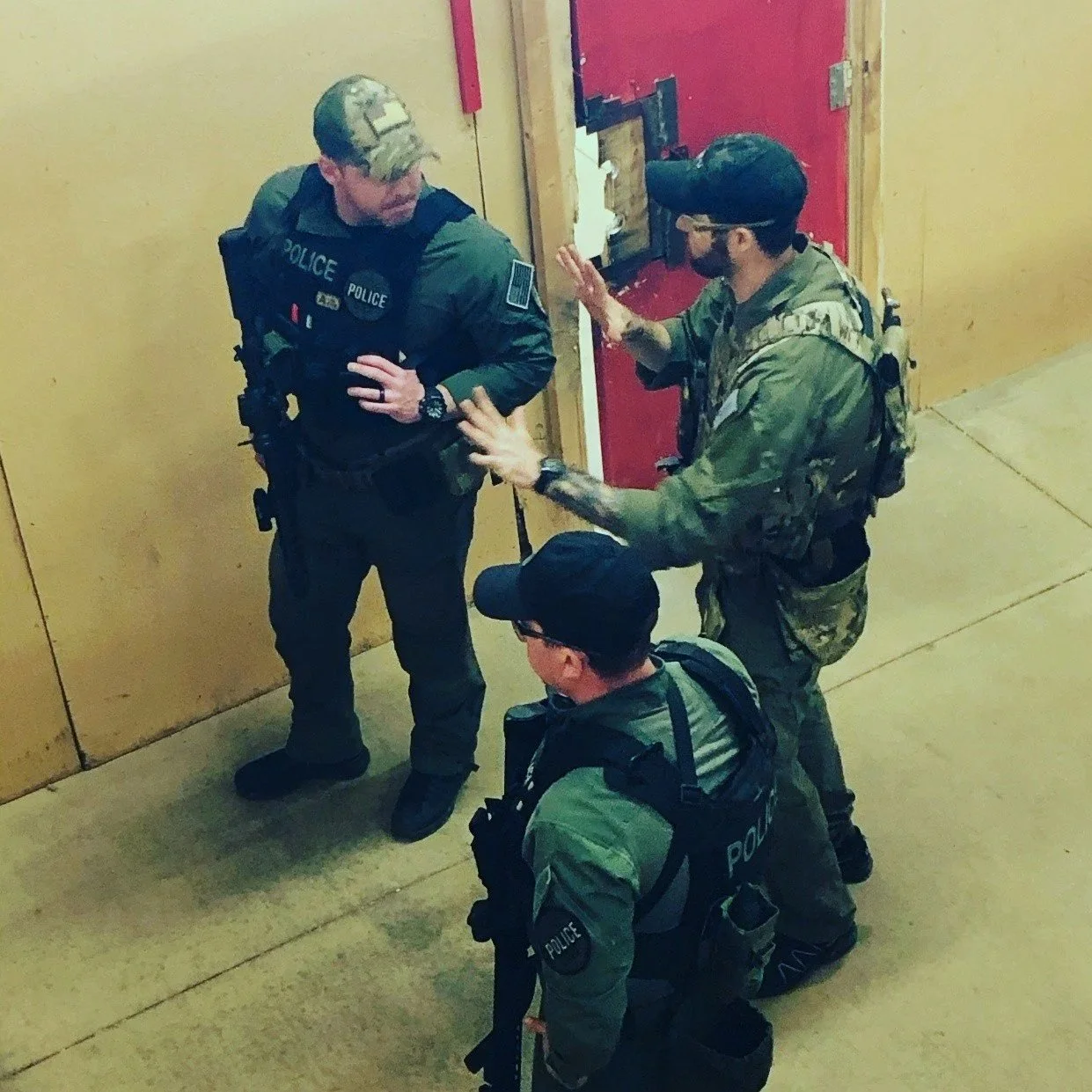
In the beginning there was the development of room entry for the purposes of Hostage Rescue, and the premise that "the number one man is never wrong" got elevated from a tactic, to a doctrine. It was passed down from high on the CQB mountain as a rule, a fundamental, even — depending on which pedigree it was being passed from — a Principle (capital P, etched in stone, referenced with the gravity of scripture). The reasoning, to the extent it was ever stated, goes something like this: the lead assaulter is the person closest to the problem, therefore he has the best information, therefore his reaction is the correct reaction, and the team follows.
The problem is that this reasoning contains an embedded assumption so large you could drive a truck through it, and nobody seems to question it. Even after being victimized by it so many times.
The assumption: that the lead assaulter's processing speed — his ability to take in visual information, make a decision, and act on it — is a constant. That it is reliable, predictable, and reproducible enough to build team momentum around – AND, that the assaulter behind him is also able to do the same.
Based on an observational study I've been running for twenty years, IT IS NOT. And that is the entire argument.
Why processing speed cannot be treated as a constant, anywhere in the stack
"Processing speed" is the outcome of a combination of your visual intake, your decision cycle, and your motor response. In a team CQB environment, it is not the same for every person on every iteration. It is affected by genetics, experience level, training recency, fatigue, heart rate at the moment of entry, lighting conditions, obstructions at or around the threshold, and the specific geometry of what's actually in front of the lead assaulter at any given moment.
That is not a short list. It is not a list that every individual can train away. Some of those variables are controllable at the margins; most are not. Heart rate alone — well-documented to degrade cognitive performance — fluctuates between iterations of the same drill on the same day with the same individual.
This means that building your team’s entry momentum around the real-time, in-the-moment decision of a single person is building it around the least reliable variable in the system. And that has consequences — specific ones.
What actually happens behind the number one man
As the number two man, standing behind the lead assaulter at the threshold, your brain has only two possible states heading into that entry:
If the answer is the first one, you are operating in a team. Your processing bandwidth is freed up. You can project your attention past the lead assaulter, into the space that actually contains the problem. You can pre-position your body in anticipation of a known movement. Your momentum into that space is uninterrupted.
If the answer is the second one — which is exactly what "the number one man does whatever feels right" produces — here is what that actually looks like in sequence:
- Your attention goes onto the lead assaulter, not onto the threat space. You are now watching a person instead of solving a problem.
- You visually process his movement, run it through your decision cycle, and then generate your own response based on what you just saw him do. This is a reactionary gap. It is built into the system by design, and it degrades team momentum at precisely the moment momentum matters most.
- Under degraded lighting without NVGs, the ability to visually process the lead assaulter's movement is impaired. The reactionary gap grows. The problem compounds.
- Under NVGs with their ~40-degree field of view, watching the lead assaulter consumes your entire visual window. The space beyond him — the space that contains the actual threat — gets none, or very little of it.
- The lead assaulter changes direction mid-threshold. This is not hypothetical. It happens. When it does, the team behind him is reacting to a second unannounced stimulus, compounding the original reactionary gap. The entry becomes a clown car.
Every one of these failure points is a direct, traceable consequence of treating the lead assaulter's real-time decision as the load-bearing element of the team's entry.
Here is the part worth sitting with: the original intent of this doctrine was not malicious. It was a practical attempt to solve a real problem — specifically, the problem of the lead assaulter freezing in the threshold whilst trying to decide which way they should go. The logic was sound enough on its face: if he knows he can’t be wrong, he won’t hesitate. He’ll rapidly commit, get out of the way, not present an obstacle himself, and allow the team’s momentum to carry into solving the problem in that space.
BUT when applied at scale across individuals of varying pedigree, it doesn't actually solve the problem. It moves the problem. The gap — the moment of “what do I do based on what I’m seeing?” — doesn’t disappear from the entry. It just bumps one position back, into the number two man’s lane. The exact cognitive delay the doctrine was designed to eliminate from the threshold is now sitting directly behind it, wearing a different jersey. The team still pays the tax. The rule just changed who writes the check.
The CQB problem is a team problem, not a series of individual ones
Here is the situation reframe that makes all of this clear: the CQB problem set is not a collection of individual actions that, when performed correctly by each person, produce a successful team outcome. That framing makes the individual the unit of analysis, which means every failure gets analyzed as an individual failure, and every solution is an individual solution.
The correct frame is the inverse. The team is the unit of analysis. The team’s job is to enter a space with maximum momentum and do the required work once inside. Anything that degrades that momentum — regardless of whether it is the result of individual confusion, hesitation, or simply an unannounced decision — is working against a successful outcome.
Viewed through that lens, the "number one man is always right" doctrine does not just permit the highly present potential for team momentum degradation. It institutionalizes it. It builds the reactionary gap into the SOP and then defends the gap as a principle.
The solution is not complicated
Call the ball. Establish a standard operating procedure: the number one man always goes [direction]. Full stop. Pick one and go with it.
Will that prescribed direction be the individually optimal answer from the lead assaulter's point of view on every single iteration in light of every single variable? No. It will not. There will be moments where a different choice, made in real time by the person closest to the problem, might have produced a marginally better individual outcome.
When set against a host of variables, across hundreds of iterations, it does not matter.
Because an iron-fisted SOP — the one every member of the team knows before they reach the threshold — eliminates or reduces most, if not all, of those individual performance variables entirely. It converts the team from a group of individuals reacting to one another into a single coordinated system executing a known task. The number two man's processing bandwidth is freed. His attention goes into the threat space. His body pre-positions. The entry team has momentum that does not hinge on what kind of day the number two man is having.
There is a secondary benefit worth naming: training time. I’ve witnessed, and my guess is that you have also been subjected to wasting enormous hours relitigating what the number one man should have done in a given scenario. That discussion, multiplied across hundreds of iterations and contextual variations, consumes valuable time that could be used building repetitions of solid team momentum into spaces and solving the actual problems, and not “majoring in the minors”. A clear SOP dispenses with the argument entirely when viewed from the correct perspective.
The bottom line
The “number one man is never wrong” doctrine is not a principle. It is an inherited assumption that has never been examined from the team’s perspective. When you examine it — when you trace the specific mechanisms by which an unannounced individual decision degrades team momentum at the threshold — the case for it collapses.
Everything else is a conversation — or more commonly a baseless emotional argument — about the wrong unit of analysis.
This is one part of a larger body of work on the CQB problem set as a team discipline. More to follow.